


Zach Kram
Multiple Authors
On Nov. 1, 2024, Shai Gilgeous-Alexander scored 30 points in a 137-114 Oklahoma City Thunder win in Portland. It wasn’t an especially notable performance at the time; Gilgeous-Alexander had averaged 30.1 points per game the previous season en route to an MVP runner-up finish.
Now, 16 months later, that game carries great historical importance, as it was the start of a 126-game odyssey for a player who has since won the regular-season MVP award, been named Finals MVP and tied a 63-year-old record.
On Thursday night against the Boston Celtics (9:30 p.m. ET, Prime Video), Gilgeous-Alexander will attempt to score at least 20 points for the 127th game in a row, dating back to that night in Portland. If he does, he’ll pass the great Wilt Chamberlain for the longest such streak in NBA history.
It’s a fitting record, based in historic consistency, for the man who once declared, “My whole life is consistent, everything I do.”
To commemorate that consistency, here are the 20 wildest, most extreme and most impressive stats about Gilgeous-Alexander’s historic 20-point streak:

1. The first surprise about Gilgeous-Alexander’s accomplishment is that he even came close to Chamberlain’s record. Nobody else had done so previously; before SGA, the second-longest 20-point streak in NBA history belonged to Chamberlain himself, at 92 games. There’s a reason Gilgeous-Alexander considers Chamberlain “almost like a mythical creature,” because his statistical feats were so singular.
Oscar Robertson’s 79-gamer was in third place — which means that for all of NBA history until this season, Chamberlain was the only player to push his streak as long as the equivalent of an entire season. And even Robertson’s streak brought him only 63% of the way to the record.
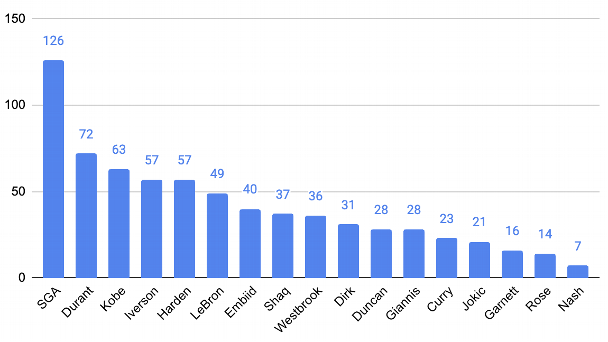
2. The competition has been even less compelling recently. In the 21st century, Kevin Durant is the only other player to get more than halfway to Chamberlain; he had a 72-gamer that started in his last season in Oklahoma City and ended early in his Warriors tenure. Next on the 21st-century list is Kobe Bryant, who reached 63 games in a row — exactly halfway to Chamberlain’s 126 — from December 2005 to November 2006.
On average, the longest 20-point streak for every MVP this century other than Gilgeous-Alexander is only 36 games.
Longest 20-point streaks from 21st-century MVPs
3. Meanwhile, the next-longest active streak behind SGA belongs to Kawhi Leonard at 42 games, and Leonard and the currently injured Joel Embiid (24 games) are the only active players whose streaks extend back to 2025, let alone 2024. Gilgeous-Alexander’s streak isn’t the result of an era effect so much as a superlative achievement from the reigning MVP — and the heavy favorite to repeat in 2025-26.
4. Against that historical backdrop, it’s worth doing some math to place the extremity of this streak in context. Over the past two seasons, during which Gilgeous-Alexander embarked on his record-setting mission, players named to an All-Star team have scored 20-plus points in 71% of their games. Given that base probability, the odds of an All-Star reaching 20-plus points 126 games in a row are about 1 in 3,200,000,000,000,000,000, or 1 in 3.2 quintillion.
The quintillion range is also the same magnitude as one estimate of the number of grains of sand on Earth. In other words, the chances of a modern NBA All-Star surpassing Chamberlain’s streak are roughly the odds of finding a specific grain of sand somewhere on the entire planet.
5. So how, exactly, did Gilgeous-Alexander beat those outrageous odds and chase down one of Chamberlain’s many long-standing records? One answer is that he excelled from every area on the court.
Splitting Gilgeous-Alexander’s 4,092 points during his streak across the general regions of the offensive end, as defined by GeniusIQ, there is a remarkably even distribution. He has scored between 16% and 25% of his points from all five areas: free throw line, restricted area, key, midrange and 3-point range.
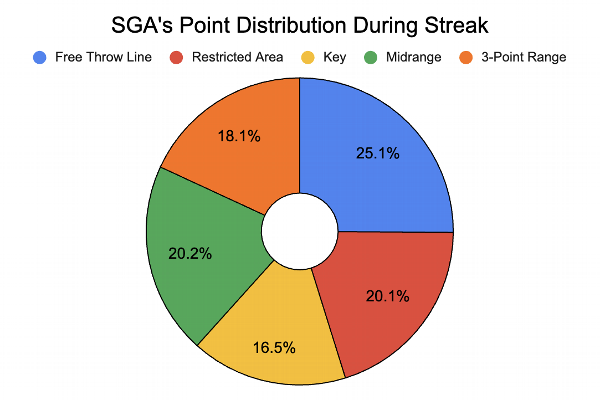
For comparison, the second-highest-scoring player over the past two seasons is Luka Doncic. And while Doncic generates a similar proportion of his points from the charity stripe (23%), he is far more skewed to 3-point range (36%) than closer to the basket (11% from the restricted area). Gilgeous-Alexander’s shot distribution is uniquely egalitarian for a guard in the modern NBA.
6. Gilgeous-Alexander is also not a static player; he has improved during his streak. He is only a 35.9% career 3-point shooter, but he’s up at 39.3% since last year’s All-Star break. That mark places him in the same range as star shooters Stephen Curry (39.8%), Kawhi Leonard (39.0%), Anthony Edwards (38.9%), Desmond Bane (38.8%), and Klay Thompson (38.4%) during that span.
7. Gilgeous-Alexander has also improved inside the arc: He’s making a career-high 60.1% of his 15 2-point attempts per game this season. That’s the most efficient 2-point performance for a guard in NBA history (minimum 10 attempts per game).
8. Gilgeous-Alexander’s overall efficiency is also near the top of the charts thanks to the combination of his improved 3-point marksmanship, historic 2-point accuracy and penchant for drawing fouls (and converting at a 90% clip from the line). With a 66.7% true shooting mark, Gilgeous-Alexander ranks second on the all-time list of 30-point scorers. Only Stephen Curry’s 66.9% figure from 2015-16 — when he won a unanimous MVP award and produced arguably the greatest offensive season in NBA history, with a record-setting 402 3-pointers — ranks higher.
9. Gilgeous-Alexander’s overall efficiency improves further because he’s not just generating positive plays, but avoiding negative ones as well. He’s averaging just 2.1 turnovers per game this season, which is the fewest on record for a player averaging 30 PPG. The previous record belonged to … Gilgeous-Alexander, who averaged 2.2 turnovers in 2023-24. And last season, he was at 2.4 turnovers per game, which is tied with Michael Jordan’s 1995-96 campaign for the third-fewest.
10. Since the start of last season, Gilgeous-Alexander naturally leads the league in 20-point games. But he is also No. 1 by a wide margin in 30-point games, with 86. Doncic is in second place with 59, which is 31% behind SGA’s total
11. Gilgeous-Alexander is also tied for the most 40-point games since the start of last season; he and Edwards have 18 apiece.
12. And even though Gilgeous-Alexander is known more as a consistent scorer than an explosive one, he also leads the league in 50-point games since the start of last season, with five. Nikola Jokic (four) is the only other player with more than two.
13. Plotting Gilgeous-Alexander’s game-by-game point totals over the course of his 126-game streak reveals another even spread. Gilgeous-Alexander has scored exactly 20 points, 21 points, 22 points and so on, all the way up to 42, at least once.
SGA’s single-game point totals during streak
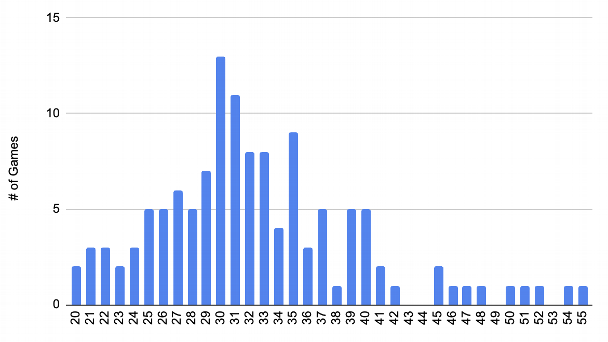
He is most often clustered in the low 30s. His modal point total during his streak is 30 points on the nose (13 times), followed by 31 (11 times), 35 (nine times) and 32 and 33 (eight times apiece).
14. Those point totals pale in comparison to Chamberlain’s, of course. The Big Dipper averaged 49.2 PPG over his record streak, compared to SGA’s 32.5. But Chamberlain also benefited from now-unheard-of playing time, as he averaged 48.4 minutes per contest and was subbed out in just three of 126 games. (In those games, he still played 45, 40 and 36 minutes.)
Gilgeous-Alexander, for comparison, hasn’t reached 48 minutes in any game during his streak and has far more games with minutes totals in the 20s (24) than 40s (five).
15. Calculating the two stars’ stats on a per-36-minute basis to even out the playing time disparity reveals a much closer competition: 36.6 points per 36 minutes for Chamberlain versus 34.4 from Gilgeous-Alexander.
16. One statistic where the two scoring superstars notably diverge is team success. Oklahoma City has gone 102-24 during Gilgeous-Alexander’s streak, compared to the Philadelphia/San Francisco Warriors’ 66-60 mark during Chamberlain’s.
17. Zooming out, Gilgeous-Alexander is on pace to average 30-plus PPG for the fourth consecutive season. The only other players in NBA history to accomplish this feat are Chamberlain (seven straight years), Jordan (seven), Robertson (four) and Adrian Dantley (four).
18. The only players to average 30-plus PPG for four straight years and win a title during that span are Gilgeous-Alexander and Jordan.
19. So, returning to Gilgeous-Alexander’s present accomplishment: How high can his 20-point streak climb? After all, Chamberlain’s streak snapped because of a fluke rather than underperformance: After 126 20-point games in a row, he was ejected just four minutes into Game 127 when he received two technical fouls for arguing a foul call against a teammate. Immediately thereafter, Chamberlain eclipsed the 20-point mark for 20 consecutive games, then missed once, then embarked on his 92-game streak.
In other words, Chamberlain was only one ill-timed argument and a few bounces away from an astonishing 240-game 20-point streak, which would have nearly doubled the actual record.
20. Gilgeous-Alexander, conversely, isn’t a threat to be ejected, and he hasn’t even had any close calls of late. Since he returned from injury at the end of February, Gilgeous-Alexander has averaged 30.8 PPG and scored at least 26 in all five games.
It’s still reasonable to expect his streak to end before too long, just given the sheer odds against even reaching triple digits, let alone continuing in perpetuity. Before his current run, SGA’s longest 20-point streaks were 37 games in 2023, 29 games in 2024 and 20 games in 2023-24. He has clearly leveled up as a scorer over the past two seasons, but plenty of other historically great scorers didn’t get anywhere near 126 games — and counting — in a row.
But that’s all the more reason to appreciate Gilgeous-Alexander’s latest achievement. Matching any of Chamberlain’s multitudinous records is worthy of celebration.


Leave a Reply